Time:
Debinding Furnace—Professional Heat Treatment Equipment
Specialized Equipment for Debinding in Powder Metallurgy and Ceramics
A debinding furnace is an industrial heat treatment device that removes organic binders from materials through high-temperature heating. It is widely used in fields such as powder metallurgy, ceramics, electronics, and new energy. The equipment employs advanced temperature control systems and atmosphere protection technology to achieve precise control over the debinding process. It features excellent temperature uniformity, low energy consumption, and safe operation,
making it an indispensable piece of key equipment in the materials processing workflow.
一.What Is a Degreasing Furnace?
A degreasing furnace is a specialized heat treatment device primarily used to remove organic binders (such as paraffin, PEG, rubber, etc.) from metal and ceramic powder injection-molded parts and to perform pre-sintering treatment on the products. The equipment uses high-temperature heating to cause the binders
to decompose, volatilize, or burn, providing a clean green body surface for subsequent sintering processes and ensuring the quality and performance of the final product.
二. What Is the Working Principle of a Degreasing Furnace?
The core working principle of a degreasing furnace is based on the synergistic interaction of the three heat transfer mechanisms: conduction, convection, and radiation. The equipment uses electric heating elements (such as resistance wires, silicon carbide rods, or infrared heaters) to convert electrical energy into thermal energy, maintaining the furnace chamber temperature within the range of 200–750°C. Within this temperature range, the organic binders in the material undergo thermal decomposition, and the decomposition products are carried out of the furnace by a carrier gas (typically nitrogen). The degreasing process typically follows a preset three-stage temperature ramp: the initial stage (below
250°C) evaporates free moisture from the green body; the intermediate stage (250–450°C) achieves the main decomposition of the binder; and the final stage (450–600°C) completes the oxidation and removal of residual carbon.
三. What are the main types of degreasing furnaces?
Based on process requirements and application scenarios, degreasing furnaces are primarily classified into the following types:
1. Combustion-type degreasing furnace
This type removes grease by direct heating and combustion, with temperatures typically controlled between 430 and 510°C. It is commonly used for the pretreatment of metal strips (such as silicon steel strips and stainless steel). This type can be used in conjunction with carburizing furnaces, utilizing exhaust gas as a heat source; however, precautions must be taken to prevent deflagration.
2. Vacuum Degreasing Furnaces
Degreasing is performed under vacuum conditions (e.g., <6 Pa). This type is suitable for high-purity materials such as tin, aluminum, and cemented carbides, with temperatures reaching up to 950°C. The vacuum environment effectively prevents oxidation, while a trap recovers the grease to prevent contamination of the furnace interior.
3. Hot-Air Circulation Degreasing Furnace
Combining low-temperature hot-air circulation (600°C) with high-temperature radiant heating (600°C), this furnace achieves temperature uniformity of ±3°C and is widely used in applications such as 3D ceramic printing and resin removal from electronic components. It features high efficiency, low energy consumption, and the ability to integrate exhaust gas purification equipment.
4. Catalytic Degreasing Furnace
This furnace utilizes catalysts such as nitric acid to accelerate binder decomposition, making it suitable for degreasing high-precision parts. It is equipped with a nitrogen protection system to control the reaction environment.
四. Structural Design
The degreasing furnace employs an advanced furnace body design to ensure stable and reliable operation:
Furnace Body Structure
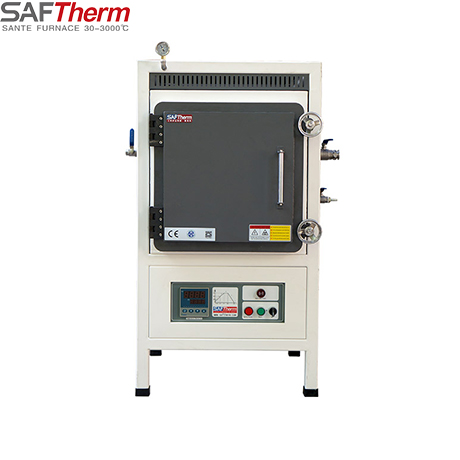
· Horizontal water-cooled jacket design, with an inner layer of SUS310S stainless steel corrugated tube and an outer layer of ordinary steel plate, capable of withstanding high temperatures and minimizing heat loss
· Double-door design facilitates loading and unloading, with an inner insulated door to reduce heat leakage
· Insulation consists of ceramic fiber composite insulation screens or nano-panels, keeping the outer casing temperature below 45°C
Heating and Temperature Control System
· Heating Methods: Resistance wire, silicon carbide rods, or infrared heating; power ranges from 20 kW to over 100 kW; heating rates up to 50°C/min
· Temperature Control: Equipped with high-precision temperature controllers supporting PID self-tuning and 400-segment programmed heating profiles; temperature control accuracy of ±0.1°C
· Some units feature three-zone independent temperature control to ensure uniform furnace chamber temperature
Atmosphere and Vacuum Systems
· Protective Gases: Inert gases such as nitrogen and hydrogen are precisely controlled via mass flow meters to maintain a slight positive pressure inside the furnace and prevent oxidation
· Vacuum System: A combination of a two-stage water-ring vacuum pump and a rotary vane pump, achieving a ultimate vacuum of up to 6 Pa; equipped with filters and explosion-proof valves to ensure safety
Exhaust Gas Treatment and Safety Protection
· VOCs Purification: Volatile organic compounds in exhaust gases are decomposed via a pyrolysis furnace, achieving a treatment efficiency exceeding 95%; emission standards meet NOx < 50 mg/m³ and total non-methane hydrocarbons < 120 mg/m³
· Multiple Safety Protections: Over-temperature alarm, thermocouple failure protection, cooling water shortage shutdown, etc., equipped with an emergency stop button and a safety explosion-proof valve.
五.Technical Parameters
| Parameter | Specification | Remarks |
|---|---|---|
| Effective Volume | 6‑800L | Customizable on request |
| Rated Working Temperature | 650‑1200℃ | Maximum operating temperature up to 1600℃ |
| Temperature Uniformity | ±3‑15℃ | Varies by furnace model |
| Temperature Control Accuracy | ±0.1℃ | PID intelligent control |
| Heating Power | 20‑100kW | Configured by furnace model |
| Vacuum Degree | ≤6Pa | Vacuum debinding furnace |
| Atmosphere Control | Nitrogen, hydrogen, etc. | Slight positive pressure protection |
| Heating Rate | 0‑50℃/min | Programmable control |
六. Application Areas of Degreasing Furnaces
Degreasing furnaces are widely used in the following industries and fields:
Powder Metallurgy
For processing metal powder products such as tungsten, aluminum, and stainless steel, vacuum degreasing furnaces are used to remove binders prior to pre-sintering, thereby improving material density and mechanical properties.
Ceramics and 3D Printing
Used for degreasing and resin removal in alumina and alumina-based ceramics. Hot-air circulation degreasing furnaces enable uniform heating during the low-temperature phase and radiant heating during the high-temperature phase, ensuring that ceramic green bodies remain free of cracking and deformation.
Electronics and New Energy
Degreasing and drying of electronic ceramic components (such as ceramic inserts), as well as cleaning and processing of new energy vehicle battery assemblies. For example, customized degreasing furnaces can reduce residual oil on fins from 300 mg/r to 1 mg/r, significantly improving soldering quality.
Aerospace
Processing high-temperature alloys and carbon fiber composites; vacuum degreasing removes binders from complex structural components, ensuring stable material performance and meeting the stringent requirements of the aerospace industry.
七. Product Features of Degreasing Furnaces
1. Excellent Temperature Uniformity
Featuring a five-sided heating design with four-sided air intake, combined with an optimized air circulation structure, this ensures uniform temperature distribution within the furnace, with temperature variations controlled within ±3–15°C.
2. Simple and Safe Operation
Equipped with a 12.1-inch touchscreen HMI that supports programmable control, enabling real-time monitoring and recording of parameters such as operating temperature and nitrogen flow rate. Features a multi-layered safety protection system, including over-temperature alarms, thermocouple failure protection, and automatic shutdown in case of cooling water shortage.
3. Energy-Efficient and Environmentally Friendly
Utilizes imported ceramic fiber insulation material for significant energy savings. Equipped with an exhaust gas treatment system that processes organic compounds before direct discharge into the atmosphere, ensuring pollution-free operation and compliance with environmental emission standards.
4. Wide Range of Applications
Suitable for degreasing a variety of materials, including stainless steel, iron-based alloys, copper alloys, tungsten alloys, and ceramics. It supports both nitric acid and oxalic acid degreasing methods and is equipped with a dual acid-feeding system.
. High Degree of Automation
Features centralized PLC control, supporting remote monitoring, fault diagnosis, and remote software upgrades. It enables fully automated program control of the entire degreasing process, reducing errors caused by manual operation.
Related News
ndustrial furnaces are used globally for a wide range of applications. As the selection of applications grew, different types of furnaces were developed to keep up with demands.
ASHING FURNACES
Ashing furnaces are used to determine the amount of ash that forms after a sample is burned. Typical materials used as samples in ashing furnaces are petroleum products, lubricating oils, and coal.
Our furnaces can be used in high-temperature tempering, annealing, quenching and other
Get A Free Quote

Submit Request